

-
 +86 18924678741
 -
 sales@hjlcharger.com
 -
 Shenzhen City, Guangdong Province, China
Understand the specifications of electric vehicle charger input lines in one article, which is applicable to both household and commercial stations
Many people get stuck in the process of selecting wires when installing electric vehicle chargers. Whether it's personal home charging, commercial use, or the construction of large public charging stations, if the wires are chosen incorrectly, it can result in unstable charging, frequent equipment tripping, or serious safety hazards caused by line heating.
Many popular science studies only focus on household low-power chargers, neglecting the selection criteria for commercial and high-power fast chargers, resulting in many people who work in stations and install high-power equipment not finding suitable references.
In fact, the selection of electric vehicle chargers follows the core of power, wiring distance, and installation environment, covering the selection logic of full power scenarios, which can be easily understood by ordinary people.
At present, the common difficulties that people face when selecting are mostly universal.
One issue is the fuzzy understanding of the corresponding wire diameter for power, with significant differences in current between different AC and DC electric vehicle chargers. When low-power wires are paired with high-power chargers, long-term full load operation can easily lead to overload.
The second issue is that it is easy to overlook the voltage drop caused by the distance of wiring. Whether it is long-distance home cables or scattered and far cables at stations, ordinary standard cables will experience losses, affecting charging efficiency and line safety.
The third issue is that the installation environment has a significant impact, with cables passing through pipes, buried underground, densely wired, and laid in enclosed spaces, resulting in poor heat dissipation conditions and potential hazards for cables that were originally sufficient.
In addition, many people are struggling with the choice between copper wire and aluminum wire. There are many low-priced aluminum wires on the market, but aluminum wires have weak current carrying capacity and are prone to oxidation and heat generation. Whether it is for long-term household use or high-frequency operation in commercial stations, they are not very suitable. Therefore, mainstream installations generally use national standard pure copper cables.
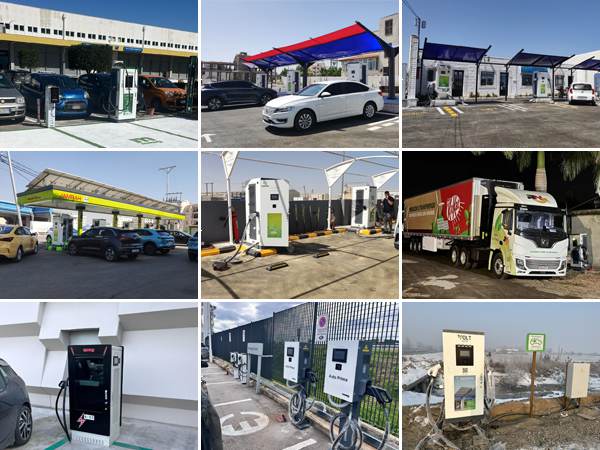
Below is a full power scenario from low to high, to share a suitable incoming line selection plan for practical use.
Low power AC chargers for household use are the most common scenario. A 3.5kW portable on-board charger with short wiring distance and conventional exposed wiring can be used with 4-square-meter national standard copper wire. A mainstream 7-kilowatt single-phase AC electric vehicle charger for home use, with good ventilation within 50 meters, and a suitable safety and cost-effectiveness of 6-square-meter copper wire; If the wiring distance is between 50 and 100 meters, or if the wiring passes through pipes or is enclosed in walls with poor heat dissipation, replacing with 10 square copper wire will be more secure. For wiring over 100 meters, 16 square copper wire can be used as appropriate.
Commercial small and medium-sized AC chargers are commonly used for upgrading shops, factories, and private parking spaces. 20 kW and 30 kW three-phase AC electric vehicle chargers, with conventional wiring within 100 meters, recommended to use 10 to 16 square national standard copper wire, suitable for continuous operating current of the equipment and daily high-frequency charging use.
The mainstream DC fast charging in public stations has higher power and current, and the selection criteria will be greatly improved. 60 kW DC fast charging, under conventional installation environment, 25 square copper wire can meet the demand. The common 120 kW and 160 kW high-power fast charging models on the market are the main models for power stations, with high continuous operating current and generally requiring copper wire of 35 square meters or more. If it is a dual gun, split type fast charging system with over 200 kilowatts, or a station with dense cables and long distances, it is also possible to upgrade to a larger wire diameter to reduce the risk of heating and voltage drop.
Overall, there is no fixed universal specification for the input of electric vehicle chargers. Don't deliberately pursue extra large wire diameters to cause waste, and don't choose smaller cables just to save money. By adjusting the selection based on device power, wiring length, installation and cooling environment, and adapting to all scenarios of household, commercial, and station use, safety, stability, and economy can be balanced.
According to the spirit of the "Notice of the...
HG POWER cordially invites you to The Energy Trans...
Based in China, connected to the world|Nigerian pa...
For electric car charging stat
EV Charging stations uk manufa
In China, the wholesale business of ev chargers co...
Do DC to DC chargers drain the main battery? A DC ...
Where are charging stations fo
What size cable is needed for
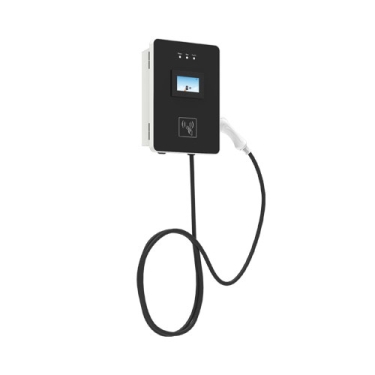
AC level 2 EV charging products that meet the standards in N...
Get last priceWhenever you need us, we're here for you. --- Contact us for all your support needs, from technology, general queries to information support, etc. Our hotline numbers and e-mail are open 24hx7d for your needs.
 +86 18924678741
sales@hjlcharger.com
Shenzhen City, Guangdong Province, China
+86 18924678741
sales@hjlcharger.com
Shenzhen City, Guangdong Province, China